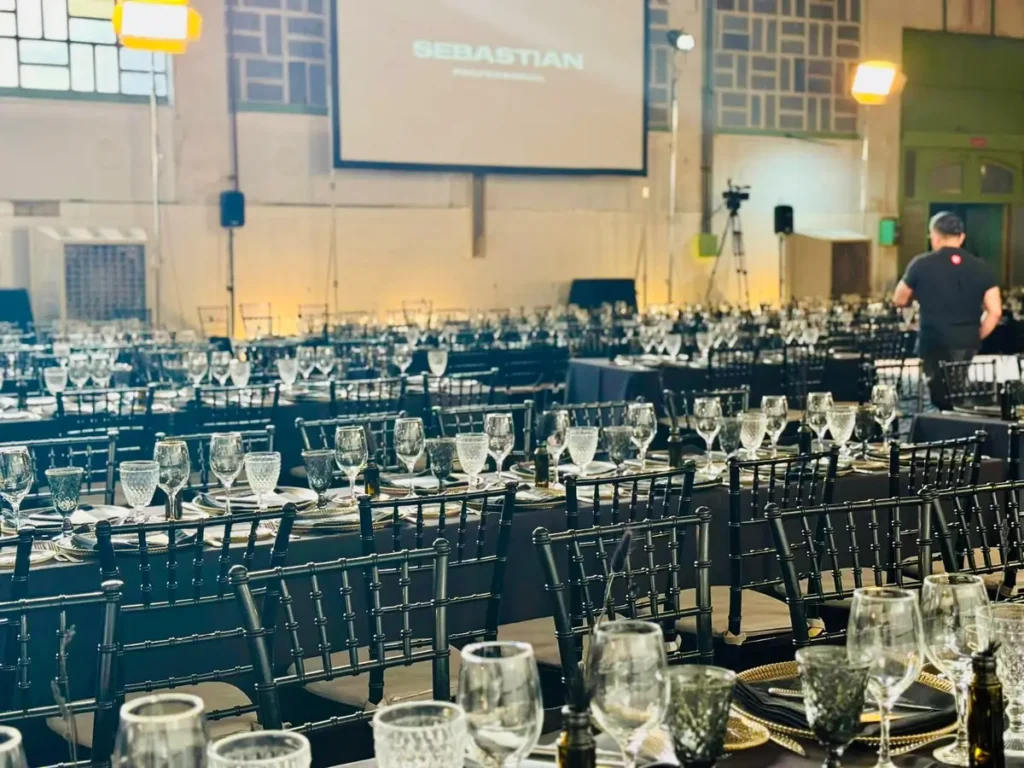
Serving 80 people well and serving 3,000 people well are not simply the same job on a different scale. At a large-scale event, quality does not depend solely on kitchen production: it depends on transportation, setup, and service functioning as a single system, at the scheduled time, and for all attendees simultaneously.
The short answer is this: the quality of catering at large events is ensured by planning tailored to the event, production capacity, standardized processes, a controlled logistics chain, coordinated teams, and supervision during service. Facilities, technology, and staff are the means to achieve this—not a guarantee in and of themselves. This guide explains each component and concludes with what you should check before hiring a caterer.
What does it mean to maintain quality at a high-volume event?
Maintaining quality at a large-scale event means that the 2,000th guest receives the same level of service as the first: a dish of the same quality, served at the right temperature, with careful presentation, and within the expected time frame.
The challenge isn't making a dish come out perfectly, but maintaining that level of quality when there are thousands of people to serve.
To achieve this, it is necessary to coordinate the kitchen, the service staff, logistics, and delivery times. If any one of these elements fails, the guest's experience may be affected.
That consistency has several aspects, and it only takes one to fall short for the customer to perceive the service as worse:
| Appearance | What Ensures Quality | What could compromise it |
|---|---|---|
| Product Quality | High-quality raw materials that are properly stored and handled. | Maintenance issues, lack of foresight, or last-minute replacements. |
| Production | Defined recipes, quantities, and processes to ensure consistent results in every serving. | Differences in preparation or a lack of control over quantities. |
| Temperature | Dishes served at the proper temperature, in accordance with storage and serving guidelines. | Delays in the preparation, transportation, or delivery of the dishes. |
| Presentation | A polished image that is consistent with the planned culinary concept. | Rushed assembly or a lack of coordination during plating. |
| Service Frequency | Meals served on schedule and at a pace appropriate for the event. | Bottlenecks in the kitchen, insufficient service stations, or slow restocking. |
| Attendee Support | A well-coordinated, informed, and prepared staff ready to meet the needs of guests, including those with special dietary requirements. | Lack of instructions, unclear roles, or incomplete information about the needs of attendees. |
The key lies in scale. A catering service equipped to handle large volumes must be able to scale up production without compromising quality standards: the quality of an event for 100 people must be the same as that of an event for thousands. If scaling up requires simplifying the menu, serving food early, or reducing the level of service, the provider isn’t scaling up—it’s cutting corners.
What needs to be planned before a large-scale event?
Before a large-scale event, you need to plan every aspect that affects production and service: who is coming, what will be served, where, and when. The larger the event, the sooner these details need to be finalized, because each one affects purchasing, work schedules, transportation, and setup.
The issues that must be resolved during the planning phase are:
- Number of attendees and their profile: how many there are and what kind of audience they are.
- Format: cocktail reception, buffet, seated banquet, food stations, or a combination.
- Menu: dishes, portions per person, and alternatives.
- Space: floor area, entrances, loading areas, support kitchen, electricity, and water.
- Schedule: setup, services provided throughout the event, and takedown.
- Service points: how many, where, and what routes attendees take.
- Dietary needs: allergies, intolerances, and special diets, including the number of people in each category.
- Forecasts: How many attendees are expected in each time slot and in each area.
- Contingencies: What to do if the number of people, the schedule, the venue, or the weather changes, especially if the event is outdoors.
If you're still planning your event or comparing vendors, this guide on how to choose catering for corporate events covers what information to request and what questions to ask before signing a contract.
How do you produce food for hundreds or thousands of people without compromising quality?
Meals for hundreds or thousands of people can be produced without compromising quality when the kitchen has sufficient capacity and follows standardized processes: technical specifications, measured quantities, preliminary tests, and quality checks at every stage. High-volume quality depends not only on a chef’s talent, but also on the entire team preparing the food consistently.
There are five tools that make this possible:
- Technical specifications: Each recipe has defined ingredients, quantities, steps, and presentation guidelines, so that the dish turns out the same no matter who prepares it.
- Standardization of production processes: the same techniques and times throughout the entire production process.
- Tastings: The dishes are tasted before the event, at the same scale at which they will be served.
- Quantity control: The amount produced is tailored to the expected number of attendees and their dietary needs.
- HACCP System: Hazard Analysis and Critical Control Points is a food safety tool that helps identify, assess, and prevent risks that may affect food during its preparation, storage, transportation, and service.
At Artigot, production is planned 20 days in advance, taking into account all scheduled events. This allows us to spread out the workload, coordinate purchases, and optimize the use of storage rooms, ensuring that a high-volume event does not interfere with the preparation of other services.
To do this, we review the menus for upcoming events together, identify the dishes that overlap, and calculate production based on the total number of guests—not on a per-event basis. For example, if there are several weddings on those dates that all feature a croquette station, the croquettes are prepared all at once for all the guests at those weddings.
Catering for large events does not follow a single model. The choice depends on the menu, the number of guests, the characteristics of the venue, and how each dish is to be served to the guests.
| Production Method | How It Works | What Influences Your Choice? |
|---|---|---|
| Central Kitchen Production | The dishes are prepared at the catering facility and transported to the event venue using appropriate preservation and transportation methods. | The type of menu, the scale of the event, and the conditions of the venue where the event is held. |
| Preparation at the event venue | The food is prepared on the premises, using the available facilities or a kitchen set up for the occasion. | The characteristics of the dishes, the preparation requirements, and the resources available in the space. |
| Mixed production | Part of the preparation takes place in the central kitchen, and the rest is completed at the event venue. | The steps involved in preparing each dish, especially when certain steps must be completed right before serving. |
At Artigot, food is prepared in the central kitchen, and some dishes are finished in the kitchen set up at the venue, always using our own equipment. A cream sauce is heated at the venue, and a sirloin steak can be cooked in the venue’s kitchen. It doesn’t depend on whether the event is large or small, but rather on adapting to the culinary offerings chosen by the client.
How is quality maintained during shipping and assembly?
Quality is maintained during transport and assembly through an unbroken cold and hot chain, traceability of everything that leaves the kitchen, and close coordination between the kitchen and the operational teams. This is the stage where the most quality can be lost without anyone noticing until the moment of service.
Storage is the first line of control: each product is transported and stored at the required temperature—chilled, hot, or frozen—using containers, carts, and equipment appropriate for each preparation method. The second is traceability, which makes it possible to know what was produced, when, and where it went. That’s why we keep records of incoming and outgoing items: everything that leaves the kitchen and everything that arrives at the event is logged and can be verified.
Timing brings everything full circle. The dish must leave the kitchen with just enough time to arrive, be plated, and served at the perfect moment—and that’s only possible if the space’s receiving, storage, prep, and service areas are clearly defined before the dish arrives.
This is where our own resources come into play. Artigot operates out of 2,500 m² of facilities, including 1,200 m² of central kitchens, four cold storage rooms, and one freezer room, and maintains its own transportation fleet of refrigerated and freezer trucks. These resources allow us to control the entire supply chain without relying on third parties, but they only work if the kitchen and operations teams follow the same plan.
At venues with their own access and setup regulations, such as trade show centers, this plan becomes even more important; we explain this in the trade show catering guide.
How can we serve a large number of people within the allotted time?
Serving a large number of people within the allotted time is achieved by properly sizing the service stations and equipment, organizing restocking and staff movement, and coordinating the timing for each area. At large events, waiting is the most common complaint, and it almost always stems from planning, not from the kitchen.
| Resource | What is it used for? | What it enables you to achieve |
|---|---|---|
| Linear meters of service | Determine the total length of the bars, buffets, and food and beverage pickup stations. | Streamline service and make it easier for guests to enjoy the dining options in comfort. |
| Number and Distribution of Service Locations | Distribute the service points throughout the different areas of the space. | Manage the flow of attendees and provide a more efficient and balanced service. |
| Heated cabinets | Maintain the proper temperature of the prepared items until they are restocked at the service stations. | Serve dishes at the correct temperature and ensure a smooth flow of service. |
| Replacement Plan | Organize when, how, and how often food is restocked at each station. | Maintain a complete and available selection throughout the entire service. |
| Trajectories of Attendees and Staff | Design the procedures for receiving, picking up, and shipping food, as well as the team's work flow. | To facilitate traffic flow, avoid unnecessary turns, and improve service coordination. |
The most effective way to manage a very large event is to break it down into smaller events. Each zone functions as its own event, with a manager in each area—kitchen, dining room, beverages, restocking—who knows the timing and their team. Before starting, each team receives a briefing, and during service, managers communicate via walkie-talkie so that any adjustments reach the right person at the right time.
What role do staff play in the quality of a catering service?
It is the teams that turn capacity into service: the kitchen, operations, logistics, and front-of-house staff must know what each person does, who they report to, and how they communicate during the event. Even a large kitchen with poorly coordinated teams produces worse results than a smaller kitchen with well-organized teams.
The first principle is that the larger the event, the more specific the roles become. At a small event, a single person handles several tasks; at an event with thousands of attendees, each team has a specific role, and the team leader understands it well and knows how to communicate it. That way, no one is left wondering what their responsibilities are once the event is underway.
The second point is that each team must make the work of the others easier. A smooth unloading process makes for a smooth setup, and a smooth setup leaves time to prepare for service instead of wasting it on unnecessary setbacks. Mistakes made in one phase don’t just disappear—they carry over to the next and eventually become noticeable in the dining room.
The third point is staff scheduling, which is handled by Human Resources in coordination with the Sales and Operations teams. Waitstaff arrival times are organized with consideration for unloading schedules, the start of service, and the subsequent cleanup, so that each phase of the event has the necessary staff at the right time and with scheduled breaks. This coordination must be finalized before the event through open communication among the three departments.
Behind this coordination are specialized teams in sales, culinary, operations, logistics, and service, each led by managers who clearly understand their roles and communicate them to their teams. For a broader overview of how teams are organized for a major event, you can read about how to organize major events.
What happens if the number of attendees changes or an unexpected situation arises?
At a large-scale event, the ability to adapt depends on what changes, when the changes are communicated, and what resources are affected. An increase in the number of attendees is not the same as a delay in the program or a change in venue access times.
At Artigot, food production allows for a 10% margin based on the expected number of attendees. This margin makes it possible to accommodate fluctuations in demand without having to improvise new dishes in the middle of service. However, this does not mean staffing beyond projected needs: teams are scheduled according to the specifics and schedules of each event.
When an unexpected situation arises, the response depends on its nature. A change in the number of attendees may require adjustments to food production and distribution; a delay in the program may affect service times, staffing, and logistics. Therefore, coordination among the Sales, Operations, Kitchen, Logistics, and Human Resources departments is essential to assess the consequences and adjust every aspect of the service.
The key is ensuring that information reaches the affected teams in a timely manner and that each person in charge knows how to respond. Scenarios that could affect execution are addressed during preliminary planning and event briefings, so that decisions are made judiciously rather than through improvisation during the event.
The most common last-minute changes—and how to avoid them from the outset—are discussed in the section on mistakes to avoid when hiring catering for corporate events.
How can a company verify that a catering service is prepared for a large-scale event?
A company can verify that a catering service is prepared for a large-scale event by requesting specific evidence: how it prepares food, how it transports it, how it organizes the service, and what comparable events it has handled. Having large facilities is not enough; what needs to be verified is that the vendor knows how to make effective use of them.
Production capacity versus execution capacity:
| Production Capacity | Ability to Execute | |
|---|---|---|
| Objective | Be able to produce the required quantity | Deliver that volume properly, on time, and in the actual location |
| Features | Kitchen counters, cold storage rooms, equipment, production | Planning, logistics, equipment, coordination, and contingencies |
| Required Resources | Facilities and Equipment | Processes, key personnel, and experience with similar events |
| How to Check It | Visiting facilities and asking about production | Requesting comparable cases and the service plan for your event |
Therefore, production capacity determines whether a catering company can prepare the food, while operational capacity determines whether it can serve it well to thousands of people; for a large event, both are necessary.
The questions you should ask any supplier are:
- What is the largest event you've ever catered for, and what kind of venue was it?
- Where is the food produced, and how many days in advance is it planned?
- How are temperature and traceability monitored from the kitchen to the dining room?
- How many points and linear meters of service do you recommend for our number of attendees?
- How are the teams organized, and who is in charge of each area?
- What range of variation in attendance do you anticipate, and how are changes handled?
- What contingency plan do you have in place if the program is delayed or there is a supply failure?
- Can we visit your facilities?
Based on the answers, the rule for evaluating a vendor is simple: the largest event they’ve ever organized should be bigger than yours, and at least one should be similar in format and type of venue. A multi-day event also requires extensive preparation: Artigot’s work on the Formula 1 Grand Prix in Madrid began a year in advance.
Summary: How to Determine Whether a Catering Service Ensures Quality at a Large Event
To determine whether a catering service can guarantee quality at a large event, check these five things before hiring them:
- Planning: Request a plan that includes attendees, format, venue, schedule, service points, dietary needs, and contingencies.
- Production: Ask where and how it is produced, what technical specifications are used, and how far in advance.
- Logistics: Confirm how temperature control and traceability are maintained until the product is served.
- Service: Check how many points and linear meters are proposed and how the restocking is organized.
- Teams and experience: who is responsible for each area and what events similar to yours have they organized?
If you'd like to plan a large-scale event based on these criteria, you can request a quote on our corporate event catering page.
Frequently Asked Questions
How can a catering service serve thousands of people while maintaining quality?
A catering company can serve thousands of people while maintaining quality if it follows standardized procedures and specifications, monitors temperature and traceability during transport, properly scales its service points, and divides the event into zones, each with a designated manager.
What capacity should a catering service have for a large-scale event?
A catering service for a large-scale event must have the production capacity to handle the expected volume, cold storage and freezer facilities, appropriate transportation, and sufficient staff in the kitchen, logistics, and dining areas. In addition, it must have experience hosting events of a similar size.
How is food quality monitored during transport?
The quality of the food during transport is ensured through the use of refrigerated or frozen vehicles, containers, and storage units that maintain the appropriate temperature, as well as records of when goods are received and shipped, and carefully calculated transit times to ensure the product arrives at its peak.
How do you calculate the number of staff needed for a large-scale event?
The staffing requirements for a large-scale event are determined based on the number of attendees, the event format, the service stations, and the schedule. The larger the event, the more specific the roles become, and each area requires its own manager.
What questions should a company ask before hiring a caterer for thousands of attendees?
Before hiring a caterer for thousands of attendees, a company should ask about the largest event the caterer has handled, where and how it operates, how it controls temperature and ensures traceability, how many service stations it plans to set up, what production margin it allows for fluctuations in attendance, and what contingency plan it has in place.